Prince Rogers Nelson was born, in Minneapolis, Minnesota,. His father was a pianist and songwriter and his mother was a jazz singer. Prince was named after his father, whose stage name was Prince Rogers, and who performed with a jazz group called the Prince Rogers Trio.
Prince's childhood nickname was "Skipper." He wrote his first tune, "Funk Machine" on his father's piano when he was seven.
Prince pioneered the "Minneapolis sound," a hybrid mixture of funk, rock, pop, R&B and New Wave. Prince has so far produced ten platinum albums and thirty Top 40 singles during his career, to date. Prince founded his own recording studio and label; writing, self-producing and playing most, or all, of the instruments on his recordings.
Prince has been a "talent promoter" for the careers of Sheila E., Carmen Electra, The Time and Vanity 6, and has written songs for these artists and others including Chaka Khan, The Bangles, and Sinéad O'Connor.
-----
After his parents separated, he moved into the home of a neighbor, and became friends with their son, Andre Anderson who later became known as André Cymone. Prince and Anderson joined Prince's cousin, Charles Smith, in a band called Grand Central while they were in high school. (Smith was later replaced by Morris Day on the drums.)
Prince played piano and guitar for the band. Grand Central later changed its name to Champagne and started playing original music. Prince also played basketball in high school.
(Continued below video and Amazon portals ...)
(Press album cover for direct link to the entire Amazon Website):
-----
In 1976, Prince created a demo tape with producer Chris Moon in Moon's Minneapolis studio. Unable to secure a recording contract, Moon brought the tape to Minneapolis businessman Owen Husney.
Husney signed Prince, at the age of 17, to a management contract and helped Prince create a demo recording at Sound 80 Studios in Minneapolis, drawing interest from several record companies. Prince signed a recording contract with Warner Bros. who agreed to give Prince creative control for three albums and ownership of the publishing rights.
Prince then left Minneapolis and moved to Sausalito, California where Prince's first album, For You, was recorded at Record Plant Studios, and released in 1978.
In 1975, Pepe Willie, the husband of Prince's cousin, Shauntel, formed the band 94 East and hired Andre Cymone and Prince to record tracks with 94 East. Prince contributed guitar tracks. Prince also co-wrote, with Willie, the 94 East song, "Just Another Sucker." The band recorded tracks which later became the album Minneapolis Genius – The Historic 1977 Recordings.
Prince released the album For You in April 1978. According to the For You album notes, Prince produced, arranged, composed and played all 27 instruments on the recording.
In October 1979, Prince released a self-titled album, Prince, which was #4 on the Billboard Top R&B/Black Albums charts, and #22 on the Billboard 200, going platinum. It contained two R&B hits: "Why You Wanna Treat Me So Bad?" and "I Wanna Be Your Lover." "I Wanna Be Your Lover" sold over a million copies, and reached #11 on the Billboard Hot 100, and #1 for two weeks on the Hot Soul Singles chart. I n 1980 Prince released the album, Dirty Mind, which he recorded in his own studio. The album was certified gold and the attendant single "Uptown" reached #5 on the Billboard Dance chart and #5 on the Hot Soul Singles charts. Dirty Mind contained sexually explicit material, including the title song, "Head," and the song "Sister."
In October 1981, Prince released the album, Controversy. In 1981, Prince formed a side project band called The Time. The band released four albums between 1981 and 1990, with Prince writing and performing most of the instrumentation and backing vocals, with lead vocals by Morris Day.
In late 1982, Prince released the double album, 1999, which sold over three million copies. The title track became his first top ten hit in countries outside the U.S. The song "Delirious" also placed in the top ten on the Billboard Hot 100 chart.
During this period Prince referred to his band as The Revolution. Prince's 1984 album Purple Rain sold more than thirteen million copies in the U.S. and spent twenty-four consecutive weeks at #1 on the Billboard 200 chart. The film of the same name won an Academy Award and grossed more than $80 million in the U.S.
-----
Prince also has several hundred unreleased songs in his "vault". He has won seven Grammy Awards, a Golden Globe, and an Academy Award. He was inducted into the Rock and Roll Hall of Fame in 2004, the first year he was eligible.
He has been known under the unpronounceable symbol, which he used between 1993 and 2000. During that period he was frequently referred to in the media as "The Artist Formerly Known as Prince," often abbreviated to "TAFKAP," or simply "The Artist."
Rolling Stone has ranked Prince #27 on its list of the 100 Greatest Artists of All Time.
During his career, Jones has sung pop, rock, R&B, show tunes, country, dance, techno, soul and gospel. He has sold over 100 million records.
-----
Thomas John Woodward, (OBE) AKA Tom Jones, was born in Treforest, South Wales. Jones began singing at an early age He is dyslexic and gained confidence through his singing.
Jones' bluesy singing style was influenced the most by American soul music. He became the frontman for Tommy Scott and the Senators, a Welsh beat group, in 1963. They soon gained a local following performing at dance halls and working men's clubs in South Wales.
In 1964, Jones recorded several solo tracks but was unsuccessful attracting a record label. One night, Jones was spotted by Gordon Mills, a London-based manager originally from South Wales at the Top Hat in Cwmtillery. Mills became Jones' manager, and took the young singer to London. Mills came up with the stage name, "Tom Jones," which not only linked the singer to the image of the title character in Tony Richardson's hit film, but also emphasised Jones' Welsh nationality.
Many record companies found Jones' stage presence, act, and vocal delivery too raucous and raunchy. Eventually, Mills got Jones a recording contract with Decca. His first single, "Chills and Fever," was released in late 1964. It didn't chart, but the follow-up, "It's Not Unusual" became an international hit. The BBC initially refused to play it, but the offshore pirate radio station Radio Caroline promoted it.
The heavily orchestrated pop arrangement perfectly meshed with Jones' swinging, sexy image, and in early 1965, "It's Not Unusual" reached number one in the U.K. and the top ten in the U.S.
During 1965, Mills secured a number of movie themes for Jones to record, including the themes for the film What's New Pussycat? and the James Bond film Thunderball. Jones was also awarded the Grammy Award for Best New Artist for 1965.
(Continued below video and Amazon portals ...)
(Press album cover for direct link to the entire Amazon Website):
-----
In 1966, Jones' popularity began to fade so Mills altered the singer's image into a more respectable and mature crooner. Jones also began to sing material that appealed to a wider audience, such as the big country hit "Green, Green Grass of Home." The strategy worked and Jones returned to the top of the charts in the UK and began hitting the Top 40 again in the USA. For the remainder of the decade, he scored a consistent string of hits on both sides of the Atlantic.
In 1967, Jones performed for the first time in Las Vegas at the Flamingo. His charismatic performances and style of dress - open, half unbuttoned shirts and tight pants - became part of his stage act. He developed a big female following. Jones decided to record less, instead concentrating on his lucrative club performances.
Jones had an internationally successful television variety show from 1969 to 1971, and from 1980 to 1981.
In the early 1970s, Jones had a number of hit singles, including "She's A Lady," "Till," and "The Young New Mexican Puppeteer," but in the mid 1970s his popularity declined, although he did have a big hit in 1976 with "Say You'll Stay Until Tomorrow," which went to #1 on the US country chart and #15 on the Billboard Hot 100.
In the early 1980s, Jones started to record country music. From 1980 to 1986, Jones had nine songs hit the top 40 on the US country chart, yet he failed to crack the top 100 in the UK or chart on the Billboard Hot 100.
After Gordon Mills died of cancer in July 1986, Jones again shifted his image and style. He Jones re-entered the singles chart in 1987 with "A Boy From Nowhere," which went to #2 in the U.K. The following year, he covered Prince's "Kiss" with The Art of Noise. The song reached #5 in the U.K. and #31 in the U.S. The video for "Kiss" was seen in heavy rotation on both MTV and VH1, and it won the MTV Video Music Award for Breakthrough Video."
In 2008, Jones released 24 Hours on S-Curve Records, his first album of new material to be issued in the US for over 15 years. Jones, who was still performing over 200 dates a year as he approached his 70th birthday, set out on a world tour to promote the album.
Jones went to the top of the UK Music Charts for the third time in his career when he covered "Islands in the Stream," sung with Ruth Jones, Rob Brydon and Robin Gibb, who co-wrote the original with his brothers Barry and Maurice. The song, inspired by BBC's hit sitcom Gavin and Stacey, was released in aid of Comic Relief and reached #1 in March 2009.
On Jones' 70th birthday, the single "Burning Hell," a cover of the John Lee Hooker classic, from his latest album, Praise & Blame album, was released.
... "Dino" was 78 years old when he passed away on Christmas Day in 1995.
Born Dino Paul Crocetti on June 7, 1917 in Steubenville, Ohio, Dean Martin's nickname was the "King of Cool." he was a major star in four areas of show business: concerts, night clubs, recordings, motion pictures, and television, and a member of the "Rat Pack" along with Frank Sinatra, Sammy Davis Jr., and Peter Lawford.
Martin's hit singles included "Memories Are Made of This,""That's Amore,""Everybody Loves Somebody,""Mambo Italiano,""Sway,""Volare" and smash hit "Ain't That a Kick in the Head?"
Martin spoke only Italian until he started school. He took up the drums as a hobby as a teenager. He was the target of much ridicule for his broken English and ultimately dropped out of Steubenville High School in the 10th grade. He delivered bootleg liquor, served as a speakeasy croupier, was a blackjack dealer, worked in a steel mill and boxed as welterweight. He grew up a neighbor to Jimmy the Greek.
At the age of 15, he was a boxer who billed himself as "Kid Crochet."Of his twelve bouts, he would later say "I won all but eleven."
Wisely, Martin gave up boxing. He worked as a roulette stickman and croupier in an illegal casino behind a tobacco shop where he had started as a stock boy. At the same time, he sang with local bands. Calling himself "Dino Martini," he got his first break working for the Ernie McKay Orchestra. He sang in a crooning style influenced by Harry Mills of the Mills Brothers, and other popular singers of the time. In the early 1940s, he started singing for bandleader Sammy Watkins, who suggested he change his name to Dean Martin.
Martin worked for various bands throughout the early 1940s, mostly on looks and personality until he developed his own singing style. Martin famously flopped at the Riobamba, a high class nightclub in New York, when he succeeded Frank Sinatra in 1943, but it was the setting for their meeting.
By 1946, Martin was doing relatively well, but was still little more than an East Coast nightclub singer with a common style, similar to that of Bing Crosby. He drew audiences to the clubs he played, but he inspired none of the fanatic popularity enjoyed by Sinatra.
Martin seemed destined to remain on the nightclub circuit until he met a comic named Jerry Lewis at the Glass Hat Club in New York, where both men were performing. Martin and Lewis formed a fast friendship which led to their participation in each other's acts and the ultimate formation of a music-comedy team. More than a few people dubbed them "The Organ Grinder and the Monkey."
Martin and Lewis's official debut together occurred at Atlantic City's 500 Club on July 24, 1946. Their success, each said, was that they essentially ignored the audience and played to one another.
The team made its TV debut on the very first broadcast of CBS-TV network's Toast of the Town Program (later called the Ed Sullivan Show.) In 1949, Martin and Lewis were signed by Paramount producer Hal B. Wallis as comedy relief for the movie My Friend Irma.
(Continued below video and Amazon portals ...)
(Press album covers for direct link to the entire Amazon Website):
Martin and Lewis were the hottest act in America during the early 1950s, but the pace and the pressure took its toll. Most critics underestimated Martin's contribution to the team, as he had the thankless job of the straight man, and his singing had yet to develop into the unique style of his later years.
Critics praised Lewis, and while they admitted that Martin was the best partner he could have, most claimed Lewis was the real talent and could succeed with anyone. However, Lewis always praised his partner, and while he appreciated the attention he was getting, he has always said the act would never have worked without Martin. The act broke up in 1956, 10 years to the day from the first official teaming.
Splitting up their partnership was not easy. It took months for lawyers to work out the details of terminating many of their club bookings, their television contracts, and the dissolution of York Productions. There was intense public pressure for them to stay together.
Lewis had no trouble maintaining his film popularity alone, but Martin, unfairly regarded by much of the public and the motion picture industry as something of a spare tire, found the going hard. His first solo film, Ten Thousand Bedrooms in 1957, was a box office failure. He was still popular as a singer, but with rock and roll gaining in popularity, the era of the pop crooner was waning. It looked like Martin's fate was to be limited to nightclubs and to be remembered as Lewis's former partner.
Never totally comfortable in films, Martin wanted to be known as a real actor. Though offered a fraction of his former salary to co-star in a war drama, The Young Lions.
Martin the starred alongside Frank Sinatra for the first time in a highly acclaimed Vincente Minnelli drama, Some Came Running. Martin was acclaimed for his performance as Dude in Rio Bravo.
As a singer, he recorded more than 100 albums and 600 songs. His signature tune, "Everybody Loves Somebody,"knocked The Beatles' "A Hard Day's Night" out of the number-one spot in the United States in 1964. This was followed by the similarly-styled "The Door is Still Open to My Heart,"which reached number six later that year. Elvis Presley was said to have been influenced by Martin, and patterned "Love Me Tender" after his style.
For three decades, Martin was among the most popular acts in Las Vegas. Martin sang and was one of the smoothest comics in the business, benefiting from the decade of raucous comedy with Lewis.
As Martin's solo career grew, he and Frank Sinatra became close friends. In the late 1950s and early 1960s, Martin and Sinatra, along with friends Joey Bishop, Peter Lawford, and Sammy Davis, Jr. formed the legendary Rat Pack. The Martin-Sinatra-Davis-Lawford-Bishop group referred to themselves as "The Summit" or "The Clan"(except for Sammy Davis) and never as "The Rat Pack,"although this has remained their identity in the popular imagination. The men made films together and formed an important part of the Hollywood social scene in those years.
In 1965, Martin launched his weekly NBC comedy-variety series, The Dean Martin Show, which exploited his public image as a lazy, carefree boozer. There he perfected his famous laid-back persona of the half-drunk crooner suavely hitting on beautiful women with hilarious remarks that would get anyone else slapped, and making snappy if slurred remarks about fellow celebrities during his famous roasts.
In December 1990, he congratulated Frank Sinatra on his 75th birthday special. By 1991, Martin had unofficially retired from performing.
Martin, a life-long smoker, was diagnosed with lung cancer at Cedars Sinai Medical Center on 16 September 1993. He died of acute respiratory failure resulting from emphysema at his Beverly Hills home on Christmas morning 1995, at the age of 78.
Martin's family was presented a gold record in 2004 for Dino: The Essential Dean Martin, his fastest-selling album ever, which also hit the iTunes Top 10. For the week ending December 23, 2006, the Dean Martin and Martina McBride duet of "Baby, It's Cold Outside" reached #7 on the R&R AC chart. It also went to #36 on the R&R Country chart - the last time Martin had a song this high in the charts was in 1965, with the song "I Will,"which reached #10 on the Pop chart.
In February 2009, Martin was honored with a post-humous Grammy award for Lifetime Achievement.
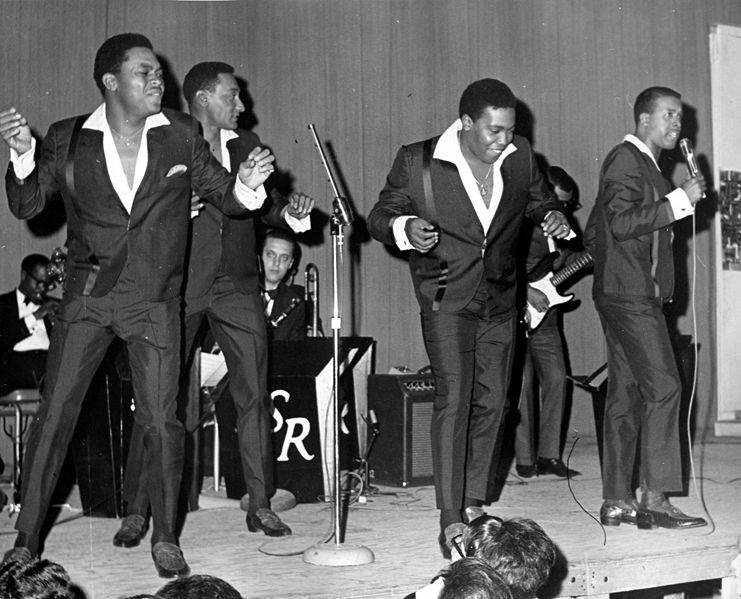
Video of the Four Tops performing "Baby I Need Your Lovin" at end of this post.
... He was 72 when he passed away from a stroke and complications from cancer on October 17, 2008.
Levi Stubbs, born Levi Stubbles in Detroit in 1936, was the lead vocalist with The Four Tops; he began his professional singing career with friends Abdul "Duke" Fakir, Renaldo "Obie" Benson and Lawrence Payton to form the Four Aims in 1954. Two years later, the group changed their name to the Four Tops. The name change was to avoid confusion with the then-popular Ames Brothers.
The group began as a supper-club act before finally signing to Motown Records in 1963. By the end of the decade, the Four Tops had over a dozen hits. The most popular of their hits - all with Stubbs on lead vocals - included "Baby I Need Your Loving," "I Can't Help Myself (Sugar Pie, Honey Bunch)," "It's the Same Old Song," "Reach Out I'll Be There," "Standing in the Shadows of Love," "Bernadette," "Still Water (Love)," "Ain't No Woman (Like the One I've Got)" as well as the late hit "Loco In Acapulco," Although Stubbs was a natural baritone, most Four Tops' hits were written in a tenor range. Levi turned down several offers for a solo career, out of loyalty to his bandmates.
As an actor, he provided the voice of the carnivorous plant "Audrey II" in the movie version of the musical Little Shop of Horrors in 1986 and the voice of Mother Brain in the animated TV series Captain N: The Game Master in 1989.
The group was inducted into the Rock and Roll Hall of Fame in 1990, and into the Vocal Group Hall of Fame in 1999. In 2004, Rolling Stone Magazine ranked them #79 on their list of the 100 Greatest Artists of All Time.
(Continued below video and Amazon portals ...)
(Press album cover for direct link to the entire Amazon Website):
-----
In 2005, The Four Tops were inducted into the Michigan Rock and Roll Legends Hall of Fame. They also received The Grammy Lifetime Achievement Award as part of the 51st Annual Grammy Awards.
Born Gary Levone Anderson in Jacksonville, Gary U.S. Bonds lived in Norfolk, Virginia, in the 1950s when he began singing in church, and with a group called The Turks. He joined record producer Frank Guida's small Legrand Records label, and Guida changed Anderson's name to U.S. Bonds in hope that it would be confused with a Public Service Announcement advertising the sale of government bonds and thus get more radio airplay. In fact, promotional copies were sent to radio stations in sleeves inscribed "Buy U.S. Bonds."
His first three singles and first album Dance 'Til Quarter To Three were released under the "U.S. Bonds" name, but people mistook it for the name of a group, so to avoid the confusion subsequent releases, including his second album Twist Up Calypso, were released under the name Gary (U.S.) Bonds. The parentheses were discarded in the 1980s.
Bonds's first hit was the song "New Orleans" which hit #6, followed by "Not Me," a flop for Bonds (but later a hit for The Orlons.) He then struck it big with his (only) number one hit, "Quarter To Three" in June 1961. "Quarter To Three" sold one million records, earning a gold disc. His other hit records in the early 1969s include "School Is Out," "Dear Lady Twist," "School Is In," and "Twist, Twist, Señora."
His records often featured solos by the saxophonist Gene Barge. (Remember the line from Quarter to Three, "Blow, blow Daddy!?" That was a shout out to Barge.)
Believe it or not, in a 1963 tour of Europe, he headlined above The Beatles when they were relative newcomers. Maybe it's not so surprising since "Quarter To Three" appears on The Rock and Roll Hall of Fame's 500 Songs that Shaped Rock and Roll list.
(Continued below video and Amazon portals ...)
(Press album cover for direct link to the entire Amazon Website):
-----
In the early 1980s, Bonds had a career resurgence with two albums Dedication and On the Line, working off collaborations with Bruce Springsteen, Steven Van Zandt, and the E Street Band. Later hits included "This Little Girl" (his comeback hit in 1981, which reached #11 on the pop chart and #5 on the mainstream rock chart), "Jolé Blon" and "Out of Work."
While Bonds is mostly known for R&B and rock and roll, he often ventures into other musical streams. His song "She's All I Got," co-written by Jerry Williams, Jr. (better known as Swamp Dogg), was nominated for the Country Music Association's "Song of the Year" in 1972 when it was a big hit for Johnny Paycheck. He is also an honoree of the Rhythm & Blues Foundation.
Bonds released an album in 2004 called Back In 20, the title referencing his repeated sporadic resurgences - every other decade. After he stumbled upon an album by Delbert McClinton, he fell in love with McClinton’s sound, and Bonds and his group, the Roadhouse Rockers, found their direction for Back In 20; blending party rock with blues. The album features guest appearances by Bruce Springsteen - who Gary met in 1980 - and Southside Johnny.
In 2009 he released a new album Let Them Talk and toured the UK as a special guest of former Rolling Stone Bill Wyman's Rhythm Kings. Most recently, in 2010, Bonds contributed duet vocals on the song "Umbrella In My Drink" on Southside Johnny's album Pills and Ammo.
Bonds continues to be a mainstay of the nostalgia concert circuit touring with the Roadhouse Rockers. He was inducted into the Long Island Music Hall of Fame on October 15, 2006.
McKnight was born in Buffalo, New York. His musical career began in childhood when he became a member of his church, NY choir and a band leader for his high school, Sweet Home High School.
In 1987, McKnight's older brother, Claude McKnight III, and his band, Take 6, signed a record deal with Warner Brothers. This encouraged McKnight to shop his own demo tapes and by the age of 19, he'd signed his first recording deal with Mercury Records subsidiary, Wing Records.
In 1992, Brian McKnight was released and was followed by two more albums for Mercury, 1995's I Remember You and 1997's Anytime.Anytime sold over two million copies and was nominated for a Grammy. In 1998, McKnight moved to Motown Records.
In 1997, McKnight recorded "Remember the Magic" for Disney World's 25th anniversary. In 1999, he released Back at One - his second release from Motown; after the Christmas album Bethlehem. Back at One sold over three million copies.
(Continued below video and Amazon portals ...)
(Press album cover for direct link to the entire Amazon Website):
-----
Throughout his career he has collaborated with a variety of musicians including Mariah Carey, Sin Bandera, Mase, Sean "Puffy" Combs, Mary J. Blige, Justin Timberlake, Nelly, Vanessa Williams, Ivete Sangalo, Kirk Franklin, For Real, Canibus, Quincy Jones, Boyz II Men, Christina Aguilera, Regine Velasquez, Shoshana Bean, Gordon Goodwin's Big Phat Band, Rascal Flatts, Talib Kweli, MJG - of the Southern Rap duo Eightball & MJG - Josh Groban, Justin Bieber, Ashley "Awesome" Speelman and CeCe Peniston.
In 2004, McKnight, co-wrote with Australian Soul artist Guy Sebastian the song "Wait" from the album Beautiful Life.
McKnight plays nine instruments: piano, guitar, bass guitar, drums, percussions, trombone, tuba, flugelhorn and trumpet. His music production sensibilities especially his piano based pop ballads, background vocal recording and melismatic voice inflections all draw heavily from James Ingram. In October 2007, McKnight made his Broadway debut in the show Chicago.
From 2006 to 2010 he hosted a radio show, The Brian McKnight Morning Show with Pat Prescott on KTWV The Wave in Los Angeles, CA. The show was at one time simulcasted on KHJZ-FM, Smooth Jazz 95.7 The Wave in Houston, TX from 6am-9am CST, but this station has changed its format. On January 26, 2009, Brian McKnight hosted "The Brian McKnight show" from 7PM-Midnight on 98.7 KISS FM in New York City.
From September 2009 to May 2010, The Brian McKnight Show, a late night talk show premiered in syndication. The show is a combination of talk and variety. The show was cancelled on May 29, 2010 due to low ratings and will not return for a second season.